

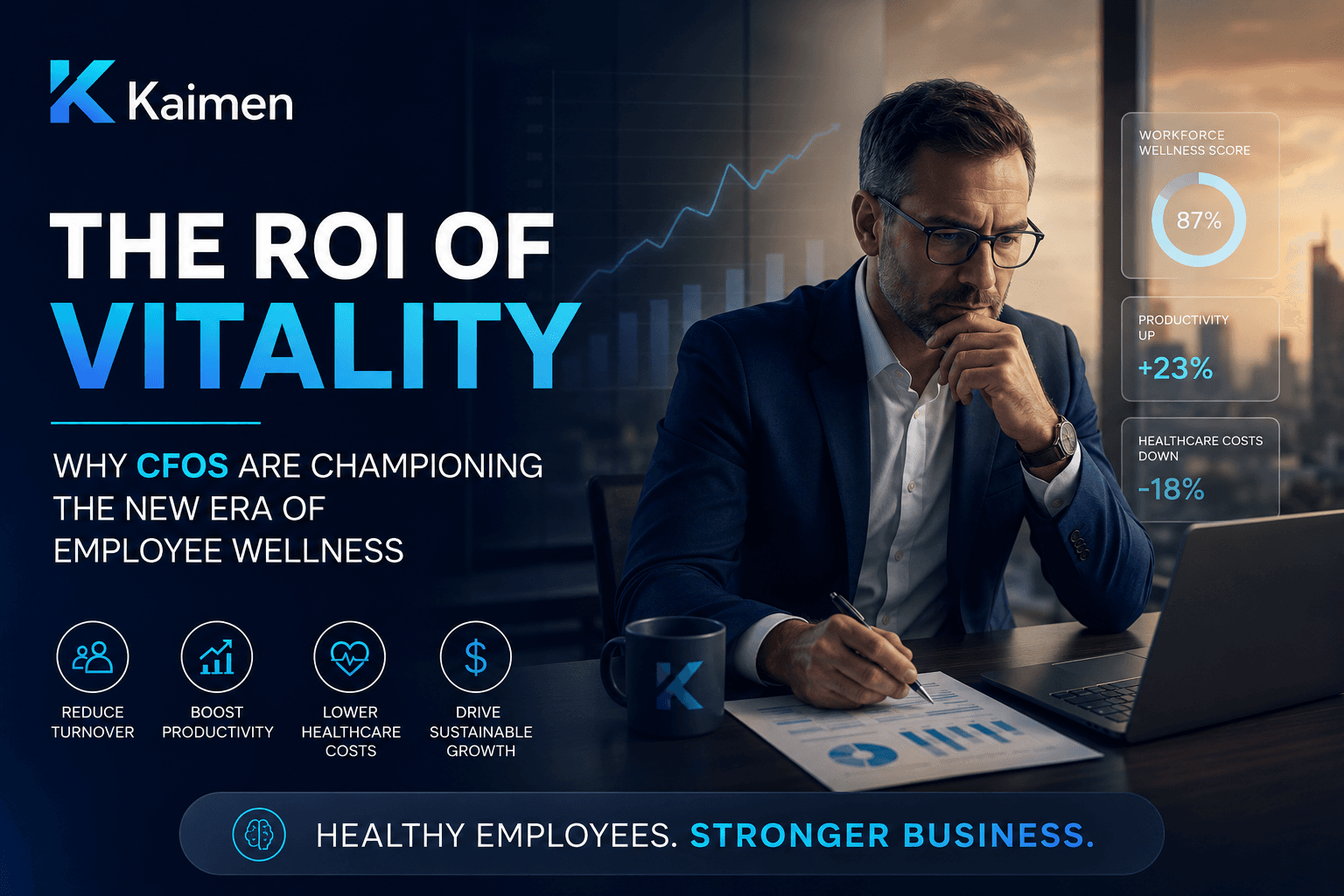
Every quarter, chief financial officers and executive teams scrutinize the balance sheet. They analyze software-as-a-service (SaaS) utilization rates, renegotiate vendor contracts, and audit operational overhead to eliminate waste.
Yet, one of the largest financial leaks in modern organizations remains completely invisible on the profit and loss (P&L) statement.
It does not appear under "software licenses" or "office rent." Instead, it is quietly distributed across recruitment fees, temporary coverage, lost productivity hours, and health insurance premiums. It is the heavy financial tax of an exhausted, disengaged, and physically depleted workforce.
Historically, when economic headwinds blew, employee wellness budgets were among the first to be trimmed. CFOs viewed them as discretionary "fluff"—a soft HR initiative with no measurable impact on the bottom line.
But a profound shift is occurring in executive boardrooms. Forward-thinking financial leaders are no longer looking at wellness as a cost center to be minimized. They are recognizing it as a strategic leverage point to protect capital, boost operational efficiency, and drive sustainable growth.
The Hidden Line Item: The True Cost of Burnout
To understand why financial leaders are stepping up to champion employee health, we must first quantify the cost of neglecting it.
When employees operate in a state of chronic stress and poor physical health, the organization pays a massive premium. This premium manifests in three major financial drains:
1. The Real Cost of Turnover
Replacing a skilled professional is not just an HR headache; it is a financial drain. Industry data consistently shows that replacing a mid-level employee costs between 1.5 to 2 times their annual salary when accounting for recruitment fees, onboarding time, and the temporary drop in team productivity. If a company loses ten key employees a year due to burnout, the financial loss easily climbs into the hundreds of thousands of dollars.
2. Absenteeism and the Presenteeism Drain
While absenteeism (employees not showing up to work) has a clear, visible cost, presenteeism (employees showing up but performing at a fraction of their capacity due to physical or mental exhaustion) is far more insidious. A team operating at 60% cognitive capacity due to poor sleep, high stress, and sedentary habits is still drawing 100% of their salary.
3. Escalating Healthcare and Insurance Costs
Compromised physical health leads directly to higher medical claims, more frequent sick leaves, and ultimately, higher corporate insurance premiums during renewal cycles.
When a CFO looks at these factors, the conclusion is clear: neglecting employee wellbeing is far more expensive than investing in it.
Shifting from ROI to VOI (Value on Investment)
Traditionally, corporate wellness programs tried to prove their worth through a strict, direct Return on Investment (ROI)—specifically trying to show an immediate reduction in medical claims. While that reduction does happen over a multi-year horizon, modern financial leaders prefer a broader metric: Value on Investment (VOI).
VOI measures the total organizational impact of a healthier workforce. It answers a more comprehensive set of questions:
- Are our teams staying with us longer, thereby reducing recruitment capital?
- Are our project delivery timelines shrinking because energy levels and focus are higher?
- Is our internal culture stronger, helping us win highly competitive talent without over-indexing on base salaries?
When vitality is treated as an active business metric, the financial output shifts. High-vitality organizations do not just save money on healthcare; they generate more revenue because their people have the cognitive and physical stamina to perform at their peak.
The Budget Trap: The Waste of Fixed Perks
If investing in wellness makes clear financial sense, why do so many corporate programs fail to satisfy the CFO?
The friction usually stems from poor capital allocation. Historically, companies fell into the "fixed perk" trap. An organization would sign a corporate contract with a single local gym chain, paying a flat rate per employee, or purchase bulk subscriptions to a single health app.
The financial reality of these programs is highly inefficient:
- Low Utilization: On average, only 10% to 15% of a workforce will regularly use a single, fixed wellness benefit. The other 85% find the location inconvenient, the offering irrelevant to their fitness level, or the scheduling incompatible with their life.
- Wasted Capital: The company pays for 100% of the contract, but only receives value for 10%. To a CFO, this is a clear misallocation of resources.
- Administration Overhead: HR teams waste hours managing individual vendor invoices, dealing with subscription renewals, and manually tracking sign-ups.
This is not a failure of wellness; it is a failure of distribution.
Flexible Allocation: The Modern CFO’s Playbook
To build a high-yield wellness strategy, organizations must move away from fixed, under-utilized contracts and transition toward flexible, demand-driven systems.
Modern corporate wellness platforms—like Kaimen—solve this exact capital efficiency problem.
Instead of forcing a company to buy rigid, uniform packages that go unused, we help organizations consolidate their wellness spend into a single, highly flexible infrastructure. Employees gain decentralized access to an entire network of gyms, fitness studios, and wellness experiences. They choose what they need, when they need it, and where they want to access it.
For the CFO, this represents a massive operational upgrade:
- Zero Waste: Budgets are allocated dynamically. Capital is spent on active, engaged utilization rather than empty, un-utilized subscriptions.
- Unified Billing: Instead of managing twenty different wellness vendors, invoices, and contracts, the finance department receives one streamlined, consolidated report.
- Data-Driven Transparency: Leaders gain clear, real-time visibility into engagement metrics, allowing them to see exactly how their investment is converting into active, healthy habits across the team.
By removing the friction of choice for employees and the friction of administration for employers, wellness transitions from an administrative burden to a highly efficient asset.
Actionable Next Steps for Executive Teams
If you want to transition your wellness budget from a cost center to a value-driving investment, consider these strategic moves:
- Analyze Your Waste: Audit your current wellness benefits. If you are paying for fixed gym corporate memberships or specific apps, request the raw utilization data. If engagement is below 20%, it is time to transition to a flexible platform.
- Consolidate Your Vendors: Simplify your administrative footprint. Look for solutions that consolidate fitness, mental health, and physical therapy into a single contract to reduce internal labor costs.
- Tie Wellness to Retention Metrics: Begin tracking employee tenure and satisfaction scores alongside wellness platform participation. You will quickly observe a strong correlation between active wellbeing habits and long-term retention.
Building a Resilient Balance Sheet
In business, we protect our physical assets with meticulous preventative maintenance. We service our servers, upgrade our software, and maintain our machinery because we know that unexpected downtime is incredibly costly.
Your employees are your most critical, complex, and expensive asset. Treating their physical and mental vitality as an afterthought is the equivalent of running machinery without ever changing the oil.
The companies that dominate the next decade will be those that understand that human sustainability is a core component of financial health.
To the business leaders in my network:
How does your organization measure the success of its wellness initiatives? If you are a CFO or financial lead, what is the biggest barrier you see when trying to justify wellness spending?
Let’s share insights in the comments below.